
What Pakistani SMEs Miss Before Expanding to a New City

A friend of mine ran a bakery in Lahore that did well enough for him to think, why not Karachi? He signed a lease within six weeks of the idea. Eighteen months later he closed the branch, having lost more money than the original bakery had made in three years. Ambition wasn’t the problem. Assuming a second city would behave like the first one that was.
Opening a new location feels like proof you’re ready to scale. But a new city isn’t just another address.it’s a different market, with its own customers, competitors, rent levels, and rules nobody warned you about. This is where good business consulting services earn their fee: not by making expansion sound simple, but by forcing the uncomfortable questions before the lease gets signed. Most owners budget for rent and renovation and stop there. They don’t ask whether demand is real, whether the math survives a bad quarter, or whether they can run two locations without either one falling apart.
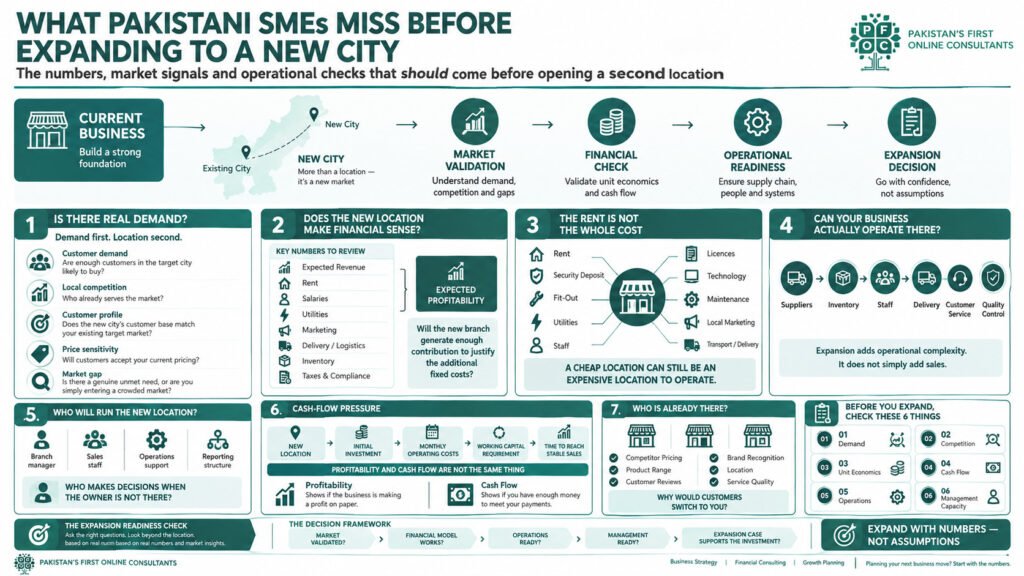
The Quick Checklist
If you’ve only got five minutes, here’s what to check before going further:
- Is your current business financially and operationally ready?
- Have you researched the target city, or just heard good things about it?
- Is customer demand validated, not assumed?
- Do you know your competitors beyond their price tags?
- Have you assessed the actual location, not just the city?
- Do you know your full setup and running costs?
- Have you separated working capital from opening capital?
- Do you know your break-even number?
- Have you checked tax, licensing, and regulatory rules?
- Is your staffing and management plan clear?
- Can your suppliers and logistics support a second site?
Now for the reasoning behind each one.
Is Your Business Actually Ready to Expand?
Before you think about which city, ask yourself something harder. If you disappeared for three weeks to set up the new branch, would your existing business still be standing when you got back? Look at your cash flow honestly. Look at your suppliers, your processes, whether your team can make decisions without phoning you first. A location that only runs well because you personally hold it together isn’t a stable business.it’s a one-person show wearing a business’s clothes. Opening a second one won’t fix that weakness. It multiplies it.
Choose the City Based on Fit, Not Size
Everyone assumes bigger cities mean bigger opportunities. Sometimes that’s true. Often it isn’t. The population isn’t in demand, and a city of twenty million people can still be a terrible fit if your customer base there is thin, price-sensitive, or already loyal to three established players. Compare cities on things that actually predict success: customer concentration, purchasing power, rent, labour costs, how easily stock moves in and out. The right city is wherever your specific business has a realistic shot at profitable customers, not wherever the crowd happens to be biggest.
Validate Demand Before You Spend a Rupee
“I think people will buy this” isn’t research. It’s a hope dressed up as a plan. Talk to potential customers in that city. Run a small ad campaign and see what clicks. Take pre-orders. Try a limited delivery test or a weekend pop-up before committing real money to a lease. Market-entry approaches across Pakistan increasingly favour exactly this kind of small, cheap testing: a failed pilot costs a few thousand rupees; a failed full branch costs your savings.
Study Competitors Beyond Their Prices
Anyone can walk into a rival’s shop and check the price tags. Fewer people bother finding out where that competitor actually falls short, slow delivery, poor service, a product gap nobody’s filling. If your pitch is only “we’re cheaper” or “we’re better quality,” that’s rarely strong enough to pull someone away from a business they already trust.
City Isn’t the Same as Location
You can nail the city and still pick the wrong street. Footfall matters. So does visibility, parking, what’s next door, how the area feels on a quiet Tuesday morning versus a packed Saturday evening. Visit at different times. A street that looks perfect at 11am might be dead by 8pm exactly the detail a rushed decision misses.
Know Your Real Costs
Rent plus renovation plus stock is the beginner’s version of a cost estimate. The real one includes recruitment, licensing, launch marketing, and the costs nobody puts on a spreadsheet until they’ve already lost money to them delayed sales in the first weeks, wasted stock, staff training, constant travel between two sites. Costs shift too much by industry and city for anyone to hand you one clean number, so don’t trust anyone who tries.
Working Capital Is Not Opening Capital
This trips up more SMEs than almost anything else. Having enough opening capital to sign a lease and stock a shelf doesn’t mean you’ve got enough working capital to survive the months before that shelf turns a profit. Ask the uncomfortable question: how many months of expenses can you fund if sales come in below forecast? No answer yet? Then you’re not ready.
Break-Even Before the Lease
Fixed costs divided by contribution margin gets you a rough break-even figure. Not complicated math but almost nobody runs it before signing a lease. Do it three ways: expected sales, lower sales, higher costs than planned. If the lower-sales scenario scares you, that’s useful information, not a reason to skip the calculation.
Compliance Isn’t One Checkbox
Pakistan’s regulatory setup spans federal, provincial, and local requirements, and a study by the Competition Commission of Pakistan covering 362 SMEs across 11 cities found regulatory and tax complexity to be a real, recurring barrier for small businesses. What applies to you depends on your business structure, sector, and exactly where you’re opening. There’s no single form that covers everyone.
Staffing, Systems, and Logistics
Who’s accountable for the branch when you’re not physically there? Decide that before opening day. Standardise what should stay consistent SOPs, service standards, cash handling and let pricing flex to local conditions. Then check what people forget entirely: can your existing suppliers reach the new city affordably, and what’s the plan when stock runs short in transit?
Protect What You Already Built
While you’re pouring energy into the new branch, who’s watching the original one? Track both separately.it’s easy for a shiny new project to mask cracks quietly forming in the business that’s actually paying your bills.
Measure After Launch
Set targets for 30, 60, and 90 days. Watch conversion rates, repeat customers, margins, cash flow. Shehr-e-Zaat Novel Guide Then make your next call scale, adjust, or pause based on those numbers, not on how the launch felt.
Common Misconceptions
“A bigger city means a bigger opportunity” ignores whether your model fits that market. “If branch one worked, branch two will too” ignores that competition and customer habits shift from city to city. “We just need enough money to open” ignores the entire ramp-up period after opening day.
Where Business Consulting Services Fit In?
Managing all of this while still running your existing business is a lot, honestly. That’s the real reason outside expertise helps not because every SME needs a consultant hovering over their shoulder, but because a second, experienced set of eyes on your market research and feasibility numbers tends to catch what you’re too close to see yourself. Good business consulting services aren’t there to replace your judgement. They’re there to sharpen it.
Frequently Asked Questions
How do I know if my business is ready to expand to another city?
Check your cash flow, systems, and whether your team can operate without you. If your first branch only works because you’re always there, you already have your answer.
How much money do I really need for a new branch?
No fixed figure costs shift with industry, city, and model. What matters more is splitting opening capital from the working capital that carries you through the slow early months.
Should I open a full branch or test the market first?
Testing first a pop-up, a pilot, a delivery-only trial is almost always the safer move. It gives you real customer evidence before you’re committed to rent, staff, and stock.
What licences do I need to expand into a new Pakistani city?
Depends on your business structure, sector, and the province you’re entering. An experienced advisor can map out exactly what applies to your case.
How can I get expert help with market entry planning?
Look for advisors who work on city assessment, financial modelling, and feasibility numbers not generic strategy talk.
The Bottom Line
Expansion should feel exciting. It should also be evidence-based, because excitement doesn’t pay rent. Know your numbers. Test small before committing fully. Protect the business you’ve already built. Decide in advance what would make you pause. None of this guarantees success, but it stops expansion from turning into an expensive lesson learned the hard way.
That’s the process PFOC (Pakistan’s First Online Consultants) helps SMEs work through turning gut feeling into evidence before a single rupee of capital goes out the door.